
Courtney Collins, Jim Winjum donate space for a critical message
By Mira Brody VP MEDIA
It's treacherous work, crossing U.S. Highway 191 on foot, as I found out last week while doing so to join a group of wildlife advocates standing under a new wildlife safety billboard just south of Gallatin Gateway. From the road's edge, I got a strong sense of what elk, deer and other creatures felt playing Frogger along a stretch of road that sees nearly 8,000 commuters from Bozeman to Big Sky each day. It was loud, overstimulating, vulnerable and not at all a task I'd want as a part of my species' survival.
As another semi truck roared by at 60 mph, I turned my attention to the north-facing billboard around which the group had gathered. The message is clear: "Elk on the road: Drive aware."
I'm crossing at what researchers from the nonprofit organization Center for Large Landscape Conservation identified in 2024 as a hotspot for wildlife-vehicle collisions. And while the data is staggering-2,625 white-tailed deer, 625 mule deer and 312 elk struck in Gallatin County between 2008 and 2022-the everyday, visual proof is in the blood-stained asphalt and frequent carcasses along the side of the highway.
Those visuals are what motivated two individuals-Courtney Collins of Courtney Collins Fine Art Gallery in Big Sky, and Jim Winjum owner of Bozeman-based Kenetrek Boots-to donate their billboard space so wildlife and driver safety messaging could be visible for both north-bound and south-bound drivers. And while it's not the ribbon-cutting event we hope to someday celebrate with a real wildlife crossing that spans the highway allowing animals to safely migrate in their habitat, the pair of billboards represent a symbolic step in a journey to get there.
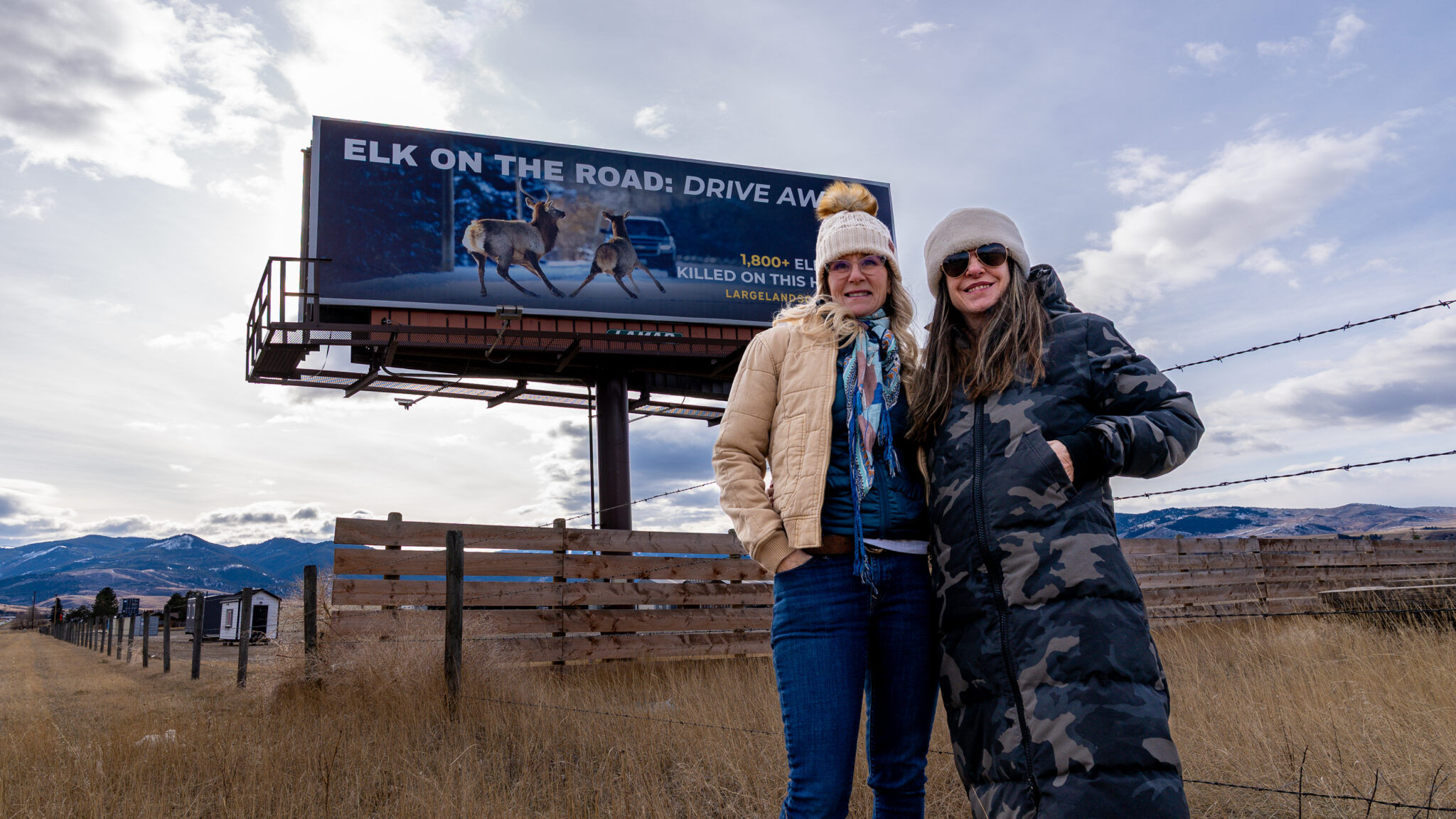
"That's that location-where the two billboards are on either end-is exactly where our wildlife crossing would go," CLLC's Chief Strategy Officer, Deb Kmon Davidson said, joined under the billboard's shadow by a handful of other CLLC staff.
The multi-stepped effort toward a permanent wildlife crossing takes patience amid "the wheels of government" that "sometimes turn slowly," said Holly Pippel. "In the long run, we're hoping for more permanent measures."
Pippel is a Gallatin Gateway photographer and wildlife advocate who uses her visual medium to communicate the dire straits local wildlife face along this corridor. Her image of elk scrambling to avoid an oncoming car on an icy roadway is featured on the billboard, which was designed by Explore Big Sky's publisher, Outlaw Partners. While organizations like CLLC and advocates like Pippel work to make that wildlife crossing a reality, the billboards will serve as a warning, conveying an important message to commuters and visitors alike.
"These two billboards are to remind drivers to be aware, slow down, keep their eyes out for elk on the road," Pippel said. "Elk cross the roads this time of year to forage, to avoid predators and hunters, to use riparian areas as they have for years and to take advantage of farmer's fields."
The next step, Pippel and Kmon Davidson explained, is that Montana Department of Transportation will approve solar-light elk crossing signage, similar to the bighorn sheep warnings drivers see as they head further south into Big Sky.
"It has been proven already by other successful wildlife crossings that if we can blend engineering with empathy, we can share the land," Collins told EBS. "I want to help the Center for Large Landscapes' efforts in any possible way I can."
While CLLC's project proposal was rejected last December, Elizabeth Fairbank, road ecologist with CLLC, told EBS shortly after that news, that their team is "not giving up on this project."
For Collins, the decision to donate her billboard was motivated by a deep love for wild things.

“For me, it stems from a deep love for animals and a desire to prevent suffering. … It hurts to think about the dangers they face, especially on busy roadways,” Collins said. “This billboard represents my commitment to raising awareness and making a positive impact, even if it is in my own unique way.”
“We’re hoping it makes a difference,” Pippel said. “We’re hoping people look up and not at their phones as they come out of the canyon and we can save a few lives.”
As we talk, cars and trucks continue to whizz by the highway. On our side of the road just up the hill from a mowed hayfield, a large herd of elk lay bedded. As our scent became wind-bound to their nostrils, a few stood to get a better view of us. I wondered if they’d try to cross the road that evening, and if they’d all make it.
“We’re distracted as a culture,” Pippel said. “It’s time to get our feet back on the ground and pay attention and start to cherish our wildlife a little more.”
